INTRODUCTION
Is it possible that the length of a person’s hair could have anything to do with pleasing God?
Such an idea may at
first seem strange.
But before the question is dismissed, it would be wise to
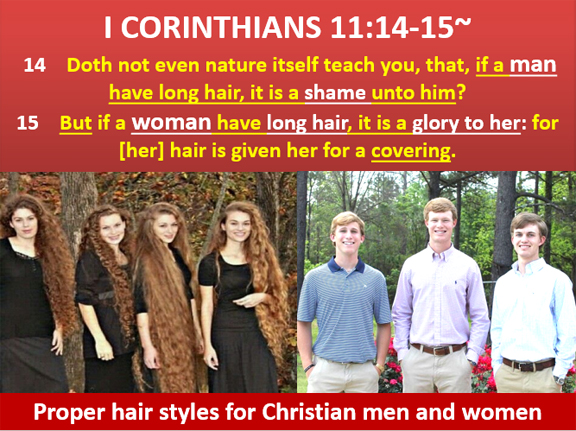
consider two statements of Scripture: “If a man have long hair, it is a
shame unto him . . . if a woman have long hair, it is a glory to her: for hair
is given her for a covering” (1 Corinthians 11:14-15).
In the
Bible, divinely appointed symbols represents things. The night Jesus was
betrayed, for example, he gave His disciples bread to eat and a cup to drink.
God has chosen for the length of people’s hair to symbolize their
relationship to him and to the authority he has placed over them. The truth is
represented in I Corinthians 11:3-16.
----------------------------------o0O0o-----------------------------------
THE PRINCIPLE OF AUTHORITY
The subject of
I Corinthians 11:13-16 is AUTHORITY:
"the head of every man is Christ; and of the head of the woman is
the man; and the head of Christ is God” (verse 3). This verse
introduces and provides the basis for the following discussion about covering
the head.
"Every man praying or prophesying, having
his head covered, dishonoureth his head." (verse 4) Christ
is man's head. It is therefore Christ who is dishonored if man prays or
prophesies with a covered head.
“But every woman that prayeth
or prophesieth with her head uncovered dishonoureth her head: for that is even
all one as if she were shaven” (verse 5).
The man (husband or father) is the head of the woman (wife or daughter). It is therefore the man who is dishonored if a woman prays or prophesies with uncovered head. This dishonor is the same as if her head were shaven.
Not only is it a shame if the woman is shaven, but it is equally a shame if she is shorn. “For if the woman be not covered, let her also be shorn: but if it be a shame for a woman to shorn or shaven, let her be covered” (verse 6). The word “shorn” is simply the past participle of “shear,” which means “to cut.” This is the meaning of the Greek word keiro, from which "shorn” is translated.
----------------------------------o0O0o-----------------------------------
SPIRITUAL SIGNIFICANCE
What is the theological basis of this teaching?
“For a
man indeed ought not to cover his head, forasmuch as he is the image and glory
of God: but the woman is the glory of the man” (verse 7). God has
chosen that a man’s uncovered head reflects His image and glory in man; woman’s
covered head reflects the glory of the man.
This reflected glory
is based on the order at creation. “For the man is not of
the woman; but the woman of the man. Neither was the man created for the woman:
but the woman for the man: (verse 8-9).
These things are
important even in the spiritual realm is revealed in the next statement:
“For this cause ought the woman to have power on her head because of
the angels” (verse 10). Angels are spirits. It is not just in the
psysical realm that the authority represented by the length of hair is
important; even angels take note of a person’s obedience or disobedience in this
matter.
After establishing the divine order of creation and of authority,
the passage affirms that a man and the woman are equally important to each other
and of equal value in the kingdom of God (verses 11-12).
----------------------------------o0O0o-----------------------------------
THE COVERING
The inspired Apostle Paul believed the church at Corinth would naturally understand the validity of his teaching on this subject: “Judge in yourselves: it is comely that a woman pray unto God uncovered? (verse 13). He did not think this should be a surprise to Christians, for the lesson of a clear distinction between male and female in this matter is deeply rooted even in nature: “Doth not even nature itself teach you, that, if a man have a long hair, it is a shame unto him? But if a woman have a long hair, it is glory to her: for her hair is given her for a covering” (verses 14-15).
The words “have long hair" in these verses are translated from Greek word komao, which means “to let the hair grow.”
The word
"hair” in verse 15 in the phrase “her hair is given her
for a covering” is translated from Greek
kome, which refers to "uncut hair".
This further explains verse 6, which declares it to be a shame if a
woman’s hair is shorn (cut) or shaven. Her long, uncut hair is
a glory to her, for it illustrates her loving submission to her husband or
father.
On the other hand, it is a shame for a man if he
allows his hair to grow uncut. For a man to cut his hair reflects his
submission to Christ; uncut hair on a man symbolizes rebellion against
Christ.
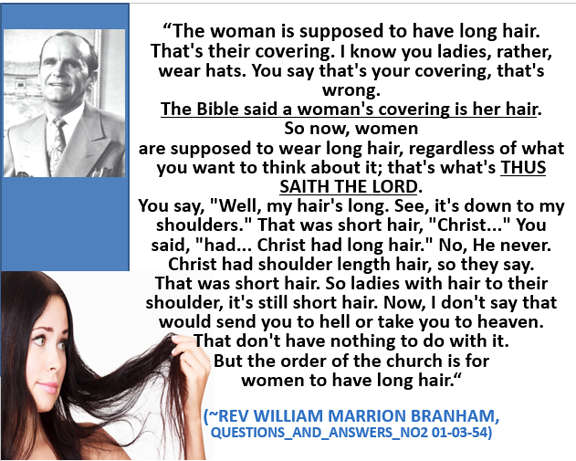
The covering mentioned in this passage is the woman’s
uncut hair. Verse 15 is the only place the word “covering” a
noun, appears in the passage. Previously, the words “uncovered”
and “covered” appear. These two words are adjectives; they do
not specifically declare what is the covering. But verse 15 specifically says,
“Her hair is given her for a covering.” The word
“for” is translated from the Greek anti, which
means “against” or “instead of.”
Here the Bible itself declares that the woman’s long, uncut hair
is given to her instead of (for) a covering, and this is the inspired
explanation of verses 5 and 6. Thus, if a woman cuts or shaves the hair
on her head, it is in the eyes of God a shameful dishonor of her father or
husband. If a man allows his hair to grow long, it is therefore a shameful
dishonor of Christ.
----------------------------------o0O0o-----------------------------------
CONTENTION
The passage
concludes, “ But if any man seem to be contentious, we have no such
custom, neither the churches of God” (verse
16).
Contention is always the result of pride (Proverbs
13:10). If any man proudly argued against this teaching, he needed to realize
that none of the churches had a custom of allowing men to pray or
prophesy with their heads covered with long, uncut hair. Nor did they permit
women to pray or prophesy unless their heads were covered with long, uncut
hair.
----------------------------------o0O0o-----------------------------------
CONCLUSION
The sincere person
who wishes to please God will want to obey His Word in every respect. He will
partake of the bread and cup of the Lord’s Supper with the greatest of
reverence, because these symbols represent the body and blood of Christ (verse
20). And a man will cut his hair while a woman will allow hers to grow,
because these symbols represent their relationship to God and to God-given
authority.
(-DLS)
----------------------------------o0O0o-----------------------------------